


.webp)



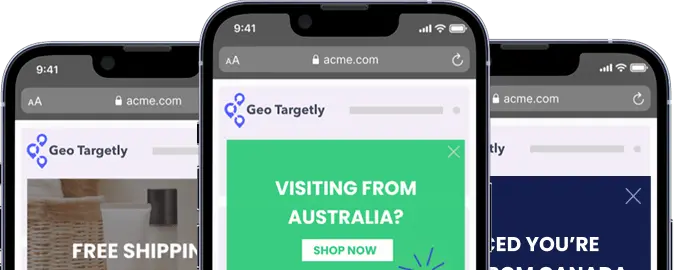






B2C ecommerce means selling products or services directly to consumers online, through your own store (DTC), marketplaces, subscriptions, or digital delivery.
To grow, focus on three levers:
- Acquisition: getting qualified traffic through SEO, paid, social, and partnerships
- Conversion: removing friction with fast pages, clear product pages, and a smooth checkout
- Retention: turning first-time buyers into repeat customers with strong post-purchase flows
If you sell internationally, localization is one of the highest-impact upgrades: show the right currency, language, shipping context, and region-specific offers so shoppers don’t have to “translate” your store mentally before they buy.
Key takeaways:
- B2C ecommerce is direct-to-consumer selling online, usually with shorter decision cycles and higher UX expectations than B2B.
- Your business model shapes everything: margins, customer acquisition strategy, and what “growth” looks like.
- High-performing stores win on fundamentals: speed, product discovery, trust signals, checkout clarity, and post-purchase experience.
- International growth requires localization, not just shipping: currency, language, region-specific messaging, and local payment preferences.
- Track the metrics that map to profit: conversion rate, AOV, CAC, LTV, cart abandonment, and return rate.
B2C e-commerce is the simplest idea in online business: you sell directly to consumers through a website, app, or marketplace.
What’s not simple is everything around it: getting traffic profitably, earning trust fast, making checkout painless, and keeping customers coming back. Add international shoppers into the mix and the details matter even more: currency, language, shipping expectations, and location-based compliance.
Our guide breaks B2C e-commerce down into the models, strategies, tech stack, and optimization tactics that actually move revenue.
What is B2C ecommerce?
Business-to-consumer (B2C) ecommerce refers to the online sale of goods or services directly from a business to individual customers. It’s the model behind online retail transactions where the buyer is a person, not another company.
This includes everything from physical products and digital downloads to subscription services.
What ties it together is the direct relationship between the brand and the consumer. There are no wholesale intermediaries. The business owns the storefront, the pricing, and the customer experience.
To understand how B2C e-commerce works in practice, it helps to compare it with its closest counterpart: B2B e-commerce.
How B2C ecommerce differs from B2B ecommerce
B2C and B2B e-commerce may use similar technology, but they operate under very different dynamics. The customer mindset, purchase process, and user experience expectations are not the same.
Here’s where they diverge.
Buying behavior
B2C purchases are usually individual decisions. They are often driven by emotion, urgency, convenience, or brand affinity.
A shopper might buy shoes after seeing a social ad. They might purchase skincare because of a promotion. The decision is usually fast and personal.
B2B buying behavior is rational and structured. Purchases are typically tied to budgets, procurement processes, and internal approvals.
Order size and frequency
B2C orders tend to be smaller but more frequent.
Examples:
- A $60 apparel order
- A $25 subscription renewal
- A $120 electronics accessory purchase
B2B orders are usually higher value and less frequent:
- Bulk software licenses
- Wholesale inventory
- Enterprise contracts
Decision cycle
B2C decision cycles are short. A consumer may discover, evaluate, and purchase within minutes.
B2B decision cycles are longer. They often involve:
- Multiple stakeholders
- Demos and trials
- Contract negotiation
- Legal or procurement review
UX expectations
B2C users expect:
- Fast page loads
- Simple navigation
- Mobile-first design
- One-click checkout
- Clear returns and shipping info
Friction kills B2C conversions.
B2B platforms often require:
- Account logins
- Custom pricing views
- Quote requests
- Contract workflows
Pricing models
B2C pricing is typically transparent and fixed. Discounts and promotions are common.
B2B pricing is often negotiated. It may include tiered pricing, volume discounts, or contract-based agreements.
Quick comparison
Types of B2C ecommerce business models
Not all B2C ecommerce businesses operate the same way. The model you choose affects margins, customer ownership, marketing complexity, and scalability.
Here are the core models, when they make sense, and how they differ.
1. Direct-to-consumer (DTC)
In the DTC model, brands sell directly to customers through their own website or app. There are no intermediaries.
This model gives you full control over the customer experience, pricing, and data. That control is powerful. It allows deeper personalization, stronger retention strategies, and higher margins compared to wholesale.
The trade-off is responsibility. You must generate your own traffic and handle fulfillment, support, and optimization yourself.
DTC works best for brands with:
- Strong positioning
- Clear differentiation
- Long-term retention goals
2. Online marketplaces
Marketplace selling means listing products on platforms like Amazon or Etsy, where the platform owns the traffic. It lowers the barrier to entry. You gain instant visibility and built-in trust.
But, you sacrifice control. Customer data is limited, platform fees eat into margins, and algorithm changes can impact revenue overnight.
Many brands use marketplaces as a validation channel before investing in DTC.
3. Subscription commerce
Subscription e-commerce charges customers on a recurring basis. Revenue becomes predictable rather than transactional.
This model works particularly well for:
- Consumables
- Routine-based products
- Digital services
The upside is lifetime value. The risk is churn. Retention systems and onboarding matter more than initial acquisition.
4. Digital products and services
Digital B2C e-commerce includes:
- Online courses
- Software subscriptions
- Media platforms
- Downloadable assets
There is no physical inventory. Margins are typically high. Distribution is global by default.
The challenge is differentiation. Digital products compete heavily on perceived value.
5. Social commerce
Social commerce integrates purchasing directly into platforms like Instagram or TikTok.
Instead of driving traffic to a website, the transaction happens within the platform.
This shortens the path to purchase and works well for impulse-driven categories.
Model comparison at a glance
Here’s a clean structural comparison:
Choosing the right B2C e-commerce model depends on:
- Your product type
- Your margin structure
- Your ability to acquire traffic
- Whether you prioritize control or convenience
Many brands combine models. For example, launching on a marketplace to test demand, then building a DTC engine for long-term profitability.
Market size and growth trends in B2C e-commerce
The B2C e-commerce landscape is large, still growing, and evolving in ways that matter for any online brand looking to scale.
Global market scale
The overall e-commerce market continues to expand rapidly. Worldwide retail e-commerce sales are projected at roughly $6.4 trillion in 2025 and expected to approach $8 trillion by 2027.
That means about 1 in 5 retail purchases is now happening online, up from roughly 20% in 2024.
At the same time, the number of online shoppers is growing, with an estimated 2.7 billion people shopping online in 2025 and that figure rising further in the coming years.
These figures reflect the sheer scale of opportunity in online retail, especially for brands that convert well and meet customer expectations.
Mobile commerce dominance
Mobile devices are now the primary way people shop online. In 2024-2025:
- Around 57%-59% of global e-commerce sales came from mobile devices.
- Mobile commerce revenue is expected to continue rising for several years.
This shift underscores how essential it is for B2C brands to deliver fast, mobile-optimized experiences with smooth browsing and checkout flows.
Social and discovery commerce
Social media platforms are no longer just referral sources, they’re commerce channels in their own right.
In 2025, social commerce was projected to account for more than 12% of online retail sales globally, with significant contributions from platforms like TikTok, Instagram, and Facebook.
For many B2C merchants, this means product discovery, community engagement, and direct buying experiences are blending together. Being effective on socials doesn’t just drive traffic, it drives conversion.
Regional dynamics
Growth rates vary by region:
- China remains the largest e-commerce market, driving a substantial portion of global online sales.
- Emerging markets in Southeast Asia, Latin America, and parts of Africa are posting double-digit growth as internet penetration and digital payments increase.
These regional differences matter for strategy. A one-size-fits-all approach tends to underperform compared with plans tailored to local behavior, currency preferences, and mobile usage patterns.
What this means for B2C e-commerce
- Scale is real, but competition is rising. More consumers are shopping online, but more brands are competing for attention.
- Mobile-first is no longer optional. With most purchases coming from smartphones, experience quality on mobile directly impacts conversions.
- Social platforms are sales channels. Brands can no longer treat social as only a marketing touchpoint, it’s part of the conversion funnel.
These trends set the context for the rest of your strategy: technology choices, personalization, conversion optimization, and international expansion all need to align with how customers increasingly discover and buy online.
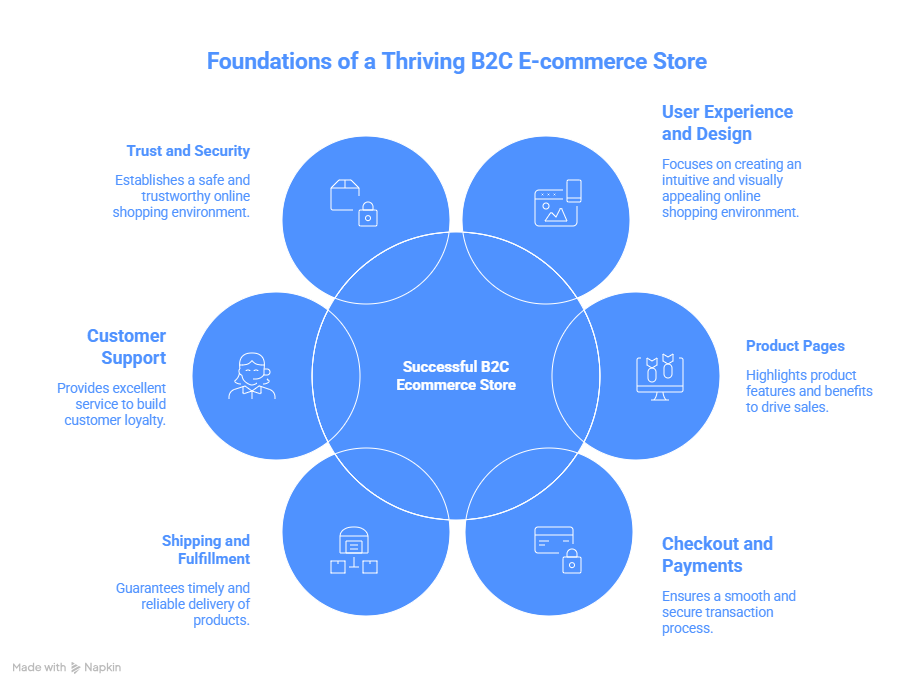
Key components of a successful B2C e-commerce store
A high-performing B2C e-commerce store is not just a website with products. It is a system designed to ease friction at every stage of the buying journey.
The strongest stores consistently get five things right: speed, clarity, trust, simplicity, and post-purchase follow-through.
1. Fast, mobile-first experience
Most B2C traffic is mobile. In many markets, it exceeds 60% of total sessions. If your store is slow or clunky on a phone, you are leaking revenue.
A strong mobile experience includes:
- Pages that load in under 3 seconds
- Clear product images optimized for small screens
- Large, tap-friendly buttons
- Autofill and mobile wallet support
Even a one-second delay can materially reduce conversion rates. Speed is not cosmetic. It is financial.
2. Clear product discovery
Visitors should be able to find what they want within seconds.
That requires:
- Logical category structure
- Filters that actually work
- Predictive search
- Clean product pages with pricing and shipping clearly visible
Confusion kills conversions faster than price objections.
3. Trust signals that reduce hesitation
Online shoppers are risk-sensitive because they can’t touch the product or talk to a salesperson. Your site must reduce perceived risk.
Core trust elements:
- Verified customer reviews
- Clear return and refund policies
- Transparent shipping timelines
- Secure payment badges
- Real contact information
When trust increases, conversion resistance decreases.
4. Frictionless checkout
Checkout is where revenue is won or lost.
Common friction points:
- Forced account creation
- Hidden shipping costs
- Unsupported local payment methods
- Long forms
Here’s a simplified view of what matters most:
Small optimizations here often produce outsized revenue gains.
5. Location-aware personalization
Global traffic is common in B2C e-commerce, but global experiences shouldn’t feel generic.
Localization can include:
- Local currency display
- Region-specific promotions
- Local shipping information
- Country-specific banners
For example, showing CAD pricing to Canadian visitors or promoting regional holidays increases relevance without requiring multiple full websites.
This is where geo-personalization tools become practical rather than cosmetic. They allow teams to tailor the experience without duplicating infrastructure.
6. Post-purchase experience
Revenue doesn’t end at checkout.
Retention drivers include:
- Clear order confirmation emails
- Delivery tracking
- Easy returns
- Follow-up recommendations
- Loyalty incentives
Retention has a measurable financial impact. Increasing customer retention by even a few percentage points can increase long-term profitability.
Technology stack for modern B2C e-commerce
Your tech stack isn’t just backend plumbing. It determines how fast you can launch campaigns, personalize experiences, expand internationally, and test new ideas.
The goal is flexibility without chaos.
Here are the core layers that matter.
1. E-commerce platform: your operational core
Your e-commerce platform is where products live, orders are processed, and inventory is managed.
Common options include:
- Shopify and Shopify Plus
- WooCommerce
- BigCommerce
- Headless platforms like Commerce Layer or Medusa
What actually matters isn’t brand name. It’s capability.
Ask:
- Can it support multi-currency and multi-language?
- Can it scale internationally without duplicating stores?
- Does it integrate cleanly with your CRM, CMS, and analytics tools?
If your platform locks you into rigid regional setups, international growth gets expensive fast.
2. Frontend and content layer
Your frontend controls speed, UX, and flexibility.
Modern teams often use:
- Next.js or Nuxt for performance and SEO
- A headless CMS like Contentful or Sanity
- Edge hosting via Vercel or Netlify
Why this matters:
- Faster load times improve conversion rates
- Modular content lets marketing teams move without dev bottlenecks
- Localized content can be swapped dynamically instead of rebuilding pages
If your content team needs a sprint cycle to change a banner, growth slows down.
3. Payments and checkout
Payment preferences vary by country. What works in the US won’t always work in the Netherlands, Germany, or India.
Strong global checkout includes:
- Local currency display
- Region-specific payment methods
- Clear tax and shipping logic
- Mobile wallet support
Here’s a simple breakdown:
Checkout is where intention becomes revenue. It’s not the place to experiment recklessly.
4. Personalization and localization tools
This is where many B2C stores fall behind.
Without personalization, every visitor sees the same experience. That’s fine in one market. It’s limiting globally.
Location-based tools allow you to:
- Show local currency without running separate domains
- Redirect users to the right store or landing page
- Display region-specific promotions
- Adjust messaging based on country
Instead of building five different country sites, you manage one core experience and adapt it dynamically. That’s operational leverage.
5. Analytics and data layer
If you can’t measure by region, you can’t optimize by region.
Your analytics stack should allow you to:
- Track conversion rate by country
- Monitor cart abandonment by currency
- Compare AOV across regions
- Measure campaign performance with UTM segmentation
Common tools include:
- Google Analytics 4
- Segment or RudderStack
- Heatmap tools like Hotjar
Data shouldn’t just exist. It should inform decisions like:
- Where to localize next
- Which markets deserve paid budget
- Where shipping friction is hurting conversions
6. CRM and retention infrastructure
Acquisition gets attention. Retention builds profit.
Your stack should support:
- Automated email flows
- Cart abandonment sequences
- Post-purchase upsells
- Loyalty programs
If retention is manual, it won’t scale.
What a modern stack actually looks like
It’s not about stacking 25 tools. It’s about clean integration.
A lean, scalable setup might look like:
- Shopify
- Stripe
- Klaviyo
- GA4
- Geo-personalization layer
- CDN with edge delivery
That’s enough to support international traffic, dynamic pricing, testing, and retention without operational chaos.
The next step is using that stack to actually attract, convert, and retain customers.
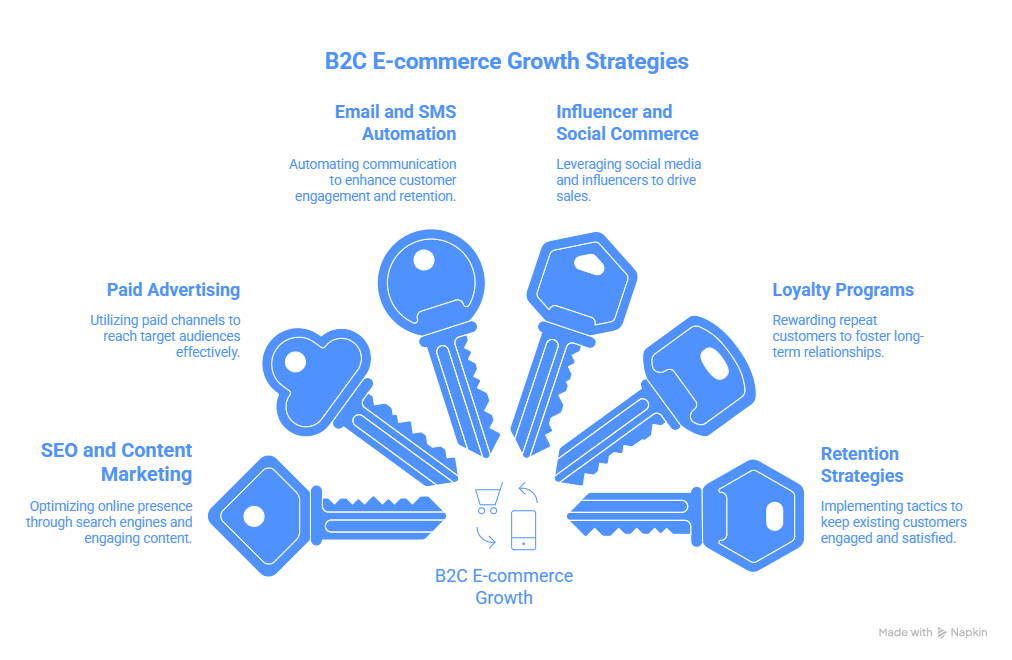
Marketing and growth strategies for B2C e-commerce
Traffic is easy to buy. Profitable growth is harder.
In B2C ecommerce, growth comes from aligning acquisition, conversion, and retention. If one breaks, the system leaks money.
Here’s what actually moves the needle.
1. SEO and content marketing
Organic traffic compounds over time. Paid traffic stops the moment you pause the budget.
For B2C brands, SEO usually falls into three categories:
- Product category pages
- Buying guides and comparisons
- Educational content tied to search intent
Example:
A skincare brand shouldn’t just rank for “vitamin C serum.” It should also rank for:
- “Best vitamin C serum for oily skin”
- “How to reduce hyperpigmentation”
- “Vitamin C vs niacinamide”
Those pages bring in qualified traffic that’s already problem-aware. The key isn’t publishing more, it’s publishing content tied to revenue-driving products.
2. Paid acquisition with margin awareness
Paid ads still work. But rising CPMs mean you can’t afford sloppy targeting.
High-performing B2C teams:
- Segment campaigns by geography
- Adjust offers by region
- Test localized landing pages
If you’re running ads globally but sending everyone to one generic page, you’re bleeding efficiency.
3. Email and SMS automation
Email remains one of the highest ROI channels in e-commerce.
Core flows every B2C brand needs:
- Welcome sequence
- Abandoned cart sequence
- Post-purchase follow-up
- Win-back campaigns
Automation matters because it scales. If you’re manually emailing customers or blasting the same newsletter to everyone, you’re leaving retention money on the table.
Segment by:
- Purchase behavior
- Location
- Product category
- Engagement level
Personalized flows outperform generic broadcasts almost every time.
4. Influencer and social commerce
Discovery increasingly happens on platforms like Instagram, YouTube, and TikTok. In some markets, social platforms are becoming direct commerce engines.
The strategy shift: Don’t treat social as just awareness, treat it as conversion.
That means:
- Platform-native checkout
- Localized influencer partnerships
- Region-specific creative
A micro-influencer in Brazil can outperform a global influencer if your goal is market penetration in Brazil.
5. Retention as a growth engine
Most brands obsess over new customers, while profitable brands obsess over repeat customers.
Retention strategies include:
- Loyalty programs
- Subscription models
- Personalized reorder reminders
- Location-aware offers
Retention matters because of simple math: Acquisition costs rise. Retention compounds. If your LTV grows while CAC stays stable, margins improve without increasing traffic.
6. Geo-personalization as a growth multiplier
This is where B2C brands quietly separate themselves. Instead of one homepage for everyone,
You create:
- Location-aware banners
- Currency-based pricing
- Region-specific promotions
- Geo-targeted landing pages
A global apparel brand might:
- Promote winter coats in Canada
- Push lightweight layers in Australia
- Run Ramadan promotions in the Middle East
Same site, but a different experience. Relevance increases conversion without increasing traffic.
Traffic is only step one. Once someone lands on your site, UX determines whether they buy or bounce.
Conversion rate optimization and UX best practices
Conversion rate optimization (CRO) and user experience (UX) go hand in hand. You can drive all the traffic you want, but if your site doesn’t convert visitors into customers, it’s wasted effort.
For e-commerce optimizing for both conversion and usability means addressing not just design and copy, but also location-based expectations.
Below are practical ways to improve both CRO and UX, with a focus on geo-personalization.
Match user expectations with geo-targeted content
Visitors from different countries expect different things when it comes to currency, language, shipping info, and even tone. If your site doesn’t reflect their local context, they’re more likely to bounce.
What to do:
- Auto-detect location using IP and show local currency, language, and shipping options.
- Highlight relevant promotions based on region. For example, run a holiday sale for Canadian visitors during Boxing Week, not just Black Friday.
- Adjust messaging to reflect local norms. A CTA that works in the US might feel aggressive in Japan.
Reduce friction in the conversion path
Every extra step or irrelevant element adds friction. For global users, this includes forms that ask for ZIP codes in the wrong format or checkout flows that don’t support local payment methods.
What to do:
- Pre-fill form fields like country or region based on IP.
- Hide or reorder fields dynamically depending on the visitor’s location.
- Use conditional logic in forms to show relevant shipping or payment options.
Personalize calls-to-action and offers
Generic CTAs miss the mark when you're dealing with a global audience. A localized CTA feels more relevant and timely, increasing the chance of a click.
What to do:
- Customize CTAs based on country or region. For example, “Start your free trial” might become “Start your 14-day EU trial” if your pricing or terms differ by region.
- Use geo-targeted popups or bars to promote local offers, deadlines, or webinars.
- Test CTA language and placement by region. What works in Germany may not work in Brazil.
Use analytics to refine location-based UX
Guesswork doesn’t scale. Use analytics to track how different regions respond to your UX changes, then iterate based on data.
What to do:
- Segment analytics by location to see where drop-offs happen.
- A/B test geo-personalized elements like banners, CTAs, and layouts.
- Monitor engagement and conversion metrics for each region separately.
CRO and UX improvements aren’t just about cleaner design or faster load times. When you tailor the experience to where your users are, you remove friction, build trust, and make it easier for them to say yes.
International B2C e-commerce and localization
International growth introduces new variables: currency, language, regulation, logistics, and cultural expectations. If those variables aren’t handled clearly, conversion rates suffer.
Localization addresses that gap.
Currency and pricing clarity
Shoppers prefer to see prices in their own currency. When they have to calculate exchange rates or guess final totals, hesitation increases.
When shoppers see the final price in their own currency, with taxes included, they’re less likely to hesitate at checkout.
Language and regional context
Translation is the starting point, not the finish line.
Effective localization can include:
- Native-language content
- Region-specific terminology
- Local promotions and seasonal campaigns
- Product recommendations based on climate or demand patterns
A winter campaign doesn’t launch at the same time in Canada and Australia. Regional context matters.
Shipping, duties, and regulatory differences
International buyers look for clarity on:
- Shipping costs
- Delivery timelines
- Duties and taxes
- Data and privacy requirements
Uncertainty in any of these areas increases abandonment.
Scaling without duplicating infrastructure
Running separate country sites increases operational overhead.
Geo-based personalization allows brands to:
- Adapt content by location
- Display region-specific pricing
- Trigger localized messaging
- Route traffic intelligently when needed
All from a single domain. Localization improves trust, and personalization improves performance.
How Geo Targetly helps B2C e-commerce brands grow
When you’re selling globally, relevance drives revenue. Geo Targetly helps B2C e-commerce brands personalize their store by location without duplicating websites or adding technical complexity.
Instead of managing separate domains for every country, you can adapt content, pricing, offers, and routing from a single site.
Here’s how Geo Targetly’s tool suite get the job done:
When someone lands on your store and something feels off, even slightly, they hesitate.
Maybe the price is in the wrong currency or the promotion doesn’t apply to their country.
Maybe the shipping info looks vague or unfamiliar. Or, perhaps they’ve ended up on a version of the site that clearly wasn’t meant for them.
None of those issues are dramatic on their own. But together, they create doubt. And doubt slows buying decisions.
Geo Targetly helps you avoid that awkward mismatch. Instead of building separate storefronts for every country, you can run one core site and tailor what people see based on where they’re browsing from.
You add one script. You define your location rules. From there, pricing, messaging, redirects, and offers adjust automatically.
For growing e-commerce brands, that means expanding into new markets without rebuilding your infrastructure every time. It also makes campaigns cleaner, since traffic from different regions lands in the right place from the start.
KPIs and metrics to track in B2C ecommerce
If you’re running a B2C ecommerce store, these are the numbers that actually shape growth decisions.
Conversion rate
Your conversion rate tells you how effectively your site turns visitors into buyers.
Conversion rate = Purchases ÷ Visitors
A 3% conversion rate might be strong for cold paid traffic, but weak for branded search or email traffic. The real insight comes from segmenting by traffic source, device, or country.
If your conversion rate in Germany is half of what it is in the US, that’s not a traffic problem. It’s likely a localization or trust issue.
Average order value
Average order value shows how much customers spend per transaction.
AOV = Total revenue ÷ Orders
Raising AOV often improves profitability faster than raising traffic. You can influence it with:
- Bundles
- Volume discounts
- Free shipping thresholds
- Location-specific promotions
As an example, if shipping costs are higher in Australia, your free shipping threshold may need to be higher there than in the UK.
Customer acquisition cost
Customer acquisition cost measures how much you spend to acquire a customer.
CAC = Total marketing spend ÷ New customers acquired
This number only makes sense when compared to lifetime value. If your CAC is $40 and your average customer only generates $45 in revenue, you don’t have a growth engine. You have a cash burn problem.
Customer lifetime value
Lifetime value estimates how much revenue a customer generates over time.
A simple version:
LTV = AOV × Purchase frequency × Retention period
LTV matters because B2C e-commerce isn’t just about the first purchase. Retention is where margins improve. Small improvements in repeat purchase rate can have outsized impact on profitability.
Cart abandonment rate
Cart abandonment shows how many users add items to cart but don’t complete checkout.
If this number is high, investigate:
- Unexpected shipping costs
- Currency confusion
- Slow checkout
- Missing local payment methods
Sometimes, the fix isn’t a redesign. It’s something small, like showing total costs upfront in the correct currency.
Revenue by region
If you’re selling internationally, don’t treat global revenue as one number.
Track:
- Revenue by country
- Conversion rate by country
- AOV by country
- Refund rate by country
This is where geo-personalization becomes measurable. If conversions rise after showing local currency or regional offers, you’ll see it in these segments.
Common challenges in B2C e-commerce and how to solve them
Every B2C ecommerce brand hits friction points. The difference between stagnation and growth usually comes down to how quickly you identify and fix them.
These are the most common ones:
B2C ecommerce doesn’t fail because of one catastrophic mistake. It usually stalls because of small friction points that compound over time: currency mismatch, shipping confusion, or generic messaging in global markets.
Fixing those friction points often produces faster returns than chasing entirely new traffic channels.
The future of B2C ecommerce
B2C ecommerce isn’t being reinvented overnight, but expectations are rising.
Three shifts are shaping the near future.
1. Personalization as baseline
Personalized experiences are no longer a competitive advantage. They’re expected.
Shoppers anticipate local currency, relevant offers, fast load times, and messaging that reflects their context. Brands that still serve the same generic experience to every visitor will see conversion gaps widen.
Location-aware personalization will continue to play a central role because it improves relevance without adding operational complexity.
2. Privacy-first marketing
With tighter regulations and reduced third-party tracking, brands are relying more on first-party data and contextual signals.
That means:
- On-site behavior
- Purchase history
- Location-based context
E-commerce teams that build around these signals will stay effective without depending on invasive tracking methods.
3. Operational simplicity at scale
International expansion is no longer optional for growth. But managing multiple storefronts, currencies, and campaigns can quickly become unmanageable.
The future favors flexible infrastructure: one core site that adapts by region instead of duplicating everything country by country.
Final thoughts
B2C e-commerce isn’t complicated in theory. You sell directly to consumers online.
What makes it challenging is scale.
As traffic grows, expectations grow with it. Shoppers expect speed, clarity, local relevance, and a frictionless checkout experience. They won’t tolerate mismatched currencies, slow pages, or generic messaging.
The brands that win aren’t necessarily the ones with the biggest budgets. They’re the ones that:
- Understand their customer behavior
- Track the right performance metrics
- Optimize conversion paths continuously
- Personalize experiences without overcomplicating infrastructure
If you’re building or refining a B2C e-commerce strategy, focus on fundamentals first: clear positioning, strong UX, localized relevance, and measurable performance.
Tools like Geo Targetly help you adapt globally without rebuilding your store for every market. That flexibility becomes more important as international traffic grows.
Growth in B2C e-commerce isn’t about doing everything, it’s about tightening what matters.
Frequently asked questions
What is the difference between B2C and DTC?
B2C describes any business that sells directly to consumers online.
DTC, or direct-to-consumer, is a specific type of B2C model where brands sell through their own website rather than through retailers or marketplaces. All DTC brands are B2C. Not all B2C businesses are DTC.
Is Amazon B2C e-commerce?
Yes. Amazon is a B2C marketplace because products are sold to individual consumers.
However, Amazon also supports B2B transactions through Amazon Business, which operates under a different model.
What platform is best for B2C e-commerce?
It depends on your goals.
- Shopify works well for fast setup and ease of use
- WooCommerce offers flexibility for WordPress users
- Headless or composable setups suit larger brands needing custom architecture
The best platform supports mobile performance, localization, payment flexibility, and integrations with marketing and analytics tools.
How do I start a B2C e-commerce business?
At a high level:
- Define your product and target audience
- Choose your business model and pricing strategy
- Set up your e-commerce platform
- Configure payments, shipping, and tax logic
- Launch with a focused marketing plan
Start narrow. Optimize before expanding.
What are the main risks of B2C e-commerce?
Common risks include:
- High customer acquisition costs
- Intense competition
- Cart abandonment
- Operational complexity in international markets
Many of these risks are manageable with strong UX, retention strategies, and location-aware personalization.

Copywriter