


.webp)









Ecommerce advertising is about buying the right traffic and turning it into revenue through relevance and alignment. High-performing campaigns match ad channels to user intent, segment audiences by behavior and location, and keep ads, landing pages, and offers consistent. Success depends on budgeting around margins, testing creative systematically, and tracking real business metrics like ROAS and CPA, not just clicks or impressions. When personalization and on-site experience support the ad message, conversion rates rise and wasted spend falls.
Key takeaways:
- Pick ad channels based on intent, not trends.
- Align ads, landing pages, and offers to reduce friction.
- Segment by intent and location to improve relevance.
- Budget around margins and break-even ROAS.
- Test creative systematically, not randomly.
- Track real performance metrics, not vanity numbers.
Ecommerce advertising has become more competitive, more expensive, and less forgiving. Costs rise quickly, attention spans are short, and small mistakes in targeting or messaging can wipe out margins.
The difference between campaigns that work and campaigns that burn budget usually isn’t channel choice. It’s how well ads match intent, how clearly offers are framed, and how fast performance is measured and adjusted.
The sections below break down the main e-commerce ad channels, how to plan campaigns around intent and margins, and how to turn clicks into revenue instead of wasted spend.
What is ecommerce advertising?
Ecommerce advertising is the use of paid channels to promote products or an online store with the goal of driving measurable results, such as purchases, leads, or signups.
Unlike broader e-commerce marketing, which includes owned and earned channels (SEO, email, organic social, referrals), advertising refers specifically to paid distribution.
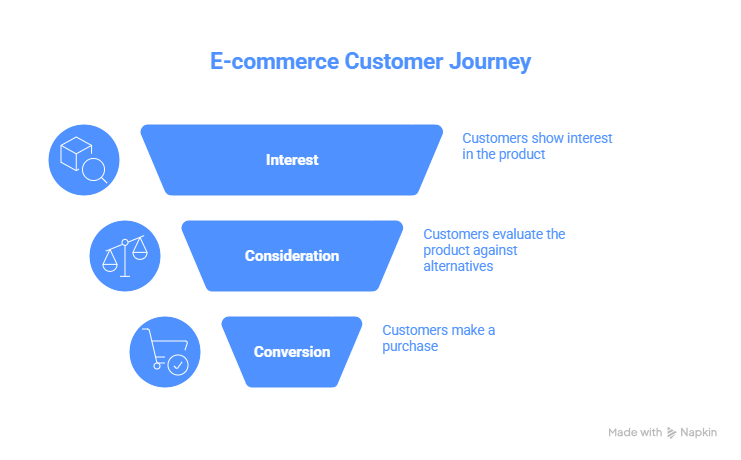
Paid ads can support different stages of the customer journey:
- Awareness: introducing your brand or product to new audiences
- Consideration: educating shoppers and building preference with proof and benefits
- Conversion: capturing high-intent buyers with offers, shopping ads, and retargeting
Most e-commerce ad performance depends on three inputs: targeting, creative, and the post-click experience. If any of those are weak, you can still spend money, but you won’t get consistent returns.
Why ecommerce advertising matters now
E-commerce is more crowded, paid platforms are more competitive, and the “free reach” most brands used to rely on keeps shrinking. At the same time, shoppers expect ads and landing pages to feel relevant right away, including the right products, pricing context, and regional details.
A few numbers put that shift into perspective:
- Competition and costs are rising: global ad spend is forecast to surpass $1 trillion in 2026 (with 5.1% growth forecast for the year).
- Paid social is a bigger slice of the pie: social media ad spend is projected at $306.4B in 2025, representing 26.2% of all advertising spend, with 14.9% growth projected that year.
- Organic reach is not a reliable growth engine: Social Status benchmarking cited in industry writeups puts average Facebook organic reach across 2024 at about 1.37%.
- Conversion gains matter because baseline rates are not huge: IRP’s e-commerce benchmark shows average conversion rate fell from 2.18% to 1.99% (December 2024 vs. December 2025).
- Efficiency matters when acquisition gets pricier: the same IRP benchmark reports average CPA increased 9.36% (December 2024 vs. December 2025).
- Relevance is a real lever: McKinsey reports personalization most often drives 10% to 15% revenue lift (with a wider range depending on execution).
Tip: Ecommerce advertising is less about buying more clicks and more about buying the right traffic, then matching it with an on-site experience that makes purchasing feel easy and obvious.
Types of ecommerce advertising channels
E-commerce advertising covers several paid channels, each suited to different goals. Some capture demand that already exists, while others help create it. Most brands use a mix, not a single channel.
Here’s how the main options compare in practice.
Paid search and shopping ads
Paid search and shopping ads appear when people actively search for products. These usually run through Google Search, Google Shopping, and Microsoft Advertising.
Shopping ads are great for e-commerce because they show product images, prices, and merchant names directly in the results.
Typical use cases
- Capturing high-intent product searches
- Promoting specific SKUs or categories
- Defending branded keywords
- Supporting promotions or seasonal demand
Paid social and video ads
Paid social and video ads run on platforms like Facebook, Instagram, TikTok, YouTube, and Pinterest. Performance depends more on creative and targeting than on search intent.
These channels are often used to introduce products, then retarget people who have already shown interest.
Typical use cases
- Product discovery
- Retargeting site visitors or cart abandoners
- Launching new products
- Driving impulse purchases
Display and programmatic advertising
Display and programmatic ads appear as banners or native placements across websites and apps. Programmatic buying uses real-time bidding to place ads based on audience data.
These channels usually support awareness and retargeting rather than direct sales.
Typical use cases
- Brand awareness
- Retargeting previous visitors
- Supporting larger campaigns
- Reinforcing other channels
Marketplace advertising
Marketplace ads promote products directly inside platforms like Amazon, Walmart, or Etsy. Ads show up in search results or on product pages. Shoppers here are close to buying, but branding control is limited.
Typical use cases
- Boosting visibility for marketplace listings
- Launching new products
- Competing on high-volume keywords
- Capturing near-purchase traffic
Emerging channels: CTV and retail media
CTV and retail media are growing options for e-commerce brands. CTV places video ads on streaming platforms. Retail media lets brands advertise inside retailer ecosystems.
These channels are mostly upper-funnel and work best alongside performance ads.
Typical use cases
- Brand awareness
- Product launches
- Supporting omnichannel campaigns
- Reaching shoppers inside retail platforms
How to build a high-performing ecommerce advertising strategy
A good ecommerce advertising strategy is less about tactics and more about alignment. When goals, targeting, creative, and landing pages point in different directions, performance suffers no matter how much you spend.
Start with clear business goals
Before setting up campaigns, decide what you are actually trying to achieve. Different goals require different channels, budgets, and expectations.
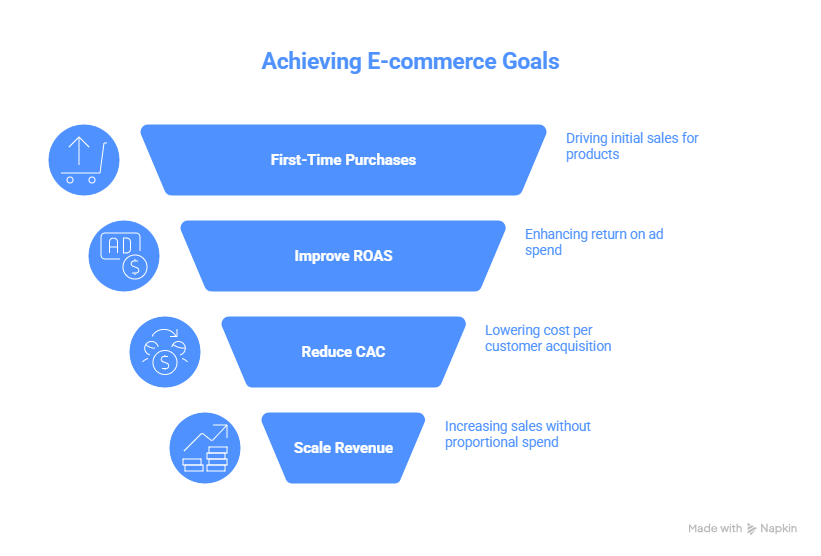
Common e-commerce goals include:
- Driving first-time purchases for a specific product or category
- Improving ROAS on existing campaigns
- Reducing customer acquisition cost in a specific market
- Scaling revenue without increasing spend at the same rate
Each goal should map to a clear metric, timeframe, and platform. Avoid vague objectives like “increase awareness” unless you are tracking how that awareness translates into downstream sales.
Choose primary and secondary channels
Not all channels deserve equal attention. Most e-commerce brands perform better by assigning roles rather than spreading budget evenly.
In practice:
- Use search and shopping ads to capture demand that already exists
- Use paid social and video to create demand and support retargeting
- Use display or CTV to reinforce awareness where it makes sense
Pick one or two primary channels that do most of the heavy lifting. Add secondary channels only when you can measure their contribution.
Segment audiences by intent and location
Treating all traffic the same is one of the fastest ways to waste budget.
At a minimum, segment by:
- New vs. returning visitors
- Product or category interest
- Purchase intent (browsing vs. ready to buy)
- Location, especially if pricing, shipping, or availability varies
High-intent segments usually justify higher bids. Lower-intent audiences need clearer value propositions or lighter spend.
Align ads with landing pages and on-site experience
If an ad makes a specific promise, the landing page should confirm it right away. The headline and offer need to match, traffic should land on the relevant product or category, and pricing, shipping details, and regional messaging should all make sense for the visitor.
When ads and landing pages feel out of sync, conversion rates usually suffer even if click-through rates look fine.
Measure, test, and adjust continuously
No e-commerce strategy stays “done” for long. Platforms change, audiences shift, and creative gets stale.
Build iteration into your process:
- Review performance frequently in the early stages
- Pause underperforming segments quickly
- Scale budgets gradually when results hold
- Test creative, targeting, and landing pages in small steps
The goal is not constant change, it’s steady improvement based on what the data is actually telling you.
Tip: Check out our guide to e-commerce analytics to learn more about what to track and what to ignore.
Audience targeting and personalization in ecommerce advertising
Generic ads underperform because they ignore context. Two users can click the same ad with very different expectations based on intent, location, and familiarity with the brand. When ads treat them the same, performance drops fast.
Effective e-commerce advertising combines targeting and personalization. Targeting gets the click, personalization is what makes that click convert.
Segment by behavior, not just demographics
Basic demographic targeting is easy to set up, but it rarely explains why someone buys.
Behavioral signals tend to be more useful, such as:
- Products viewed or added to cart
- Purchase history
- Time since last visit
- Engagement with previous ads
Someone who viewed the same product multiple times but didn’t buy is a different audience from someone seeing the brand for the first time. They should not see the same message, offer, or landing page.
Most ad platforms support custom and remarketing audiences built from these signals. Using them early usually performs better than relying on broad targeting.
Use location to make ads feel relevant
Location shapes how users interpret an offer. Pricing expectations, shipping thresholds, product availability, and even wording vary by region. Ignoring this creates friction that ads cannot overcome.
Common location-based adjustments include:
- Showing prices in local currency
- Highlighting relevant shipping times or thresholds
- Promoting products that make sense for the region
- Adjusting language or terminology
These adjustments only work if they carry through after the click. A localized ad that sends traffic to a generic landing page loses most of its advantage.
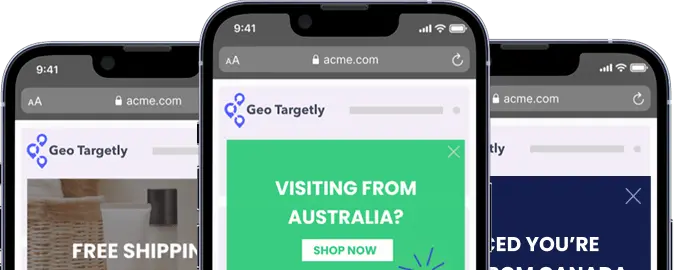
Geo Targetly helps bridge that gap by adapting landing page content based on visitor location, alongside many other helpful tools. That keeps pricing, messaging, and offers aligned with what the ad promised.
Personalize creative by audience segment
Once audiences are segmented, creative should reflect those differences.
For example:
- New visitors respond better to product benefits and social proof
- Returning visitors often need reassurance or comparisons
- Price-sensitive segments react to discounts or bundles
- High-value customers expect exclusivity or early access
Personalization does not require complex systems to start. Even a small number of creative variations, paired with location-aware landing pages, can outperform a single generic ad.
Keep the landing page consistent with the ad
Personalized ads create expectations. The landing page should confirm them.
If an ad targets a specific region or product category, the page should:
- Reinforce the same message
- Show relevant products immediately
- Reflect the correct currency, language, and offer context
When ads and landing pages feel mismatched, users hesitate. That hesitation shows up as higher bounce rates and weaker conversion performance.
Scale personalization without fragmenting campaigns
Personalization doesn’t mean building separate campaigns or sites for every segment.
Most teams scale by:
- Reusing core campaign structures
- Swapping creative or messaging by segment
- Adjusting landing page content dynamically by location
This approach keeps campaigns manageable while improving relevance and return on ad spend.
Budgeting and bidding for e-commerce ads
Budgeting and bidding work best when they’re tied to margins and outcomes, not guesswork. If you don’t know what you can afford to spend to acquire a customer, no bidding strategy will save you.
Start with margins and break-even ROAS
Before setting budgets, get clear on a few numbers:
- Average order value
- Profit margin
- Customer lifetime value, if repeat purchases matter
From there, define a break-even ROAS (Return on Ad Spend) or maximum CPA (Cost Per Acquisition. That becomes your reference point for every campaign. If you cannot hit it consistently, scale should stop.
Allocate budget by funnel stage
Not all spend should go toward immediate conversions.
In simple terms:
- Top of funnel: smaller budgets, broader reach, creative testing
- Mid funnel: steady spend on retargeting and product education
- Bottom funnel: higher bids for high-intent traffic
As performance data comes in, shift budget toward the stages that actually contribute to revenue, not just clicks.
Choose bidding strategies based on maturity
Automated bidding works best when platforms have enough data to learn from.
General guidance:
- New or low-volume campaigns: start with manual bidding or conservative CPA caps
- Established campaigns: test automated strategies like target ROAS
- Scaling campaigns: increase budgets gradually to avoid performance swings
Automation is useful, but only after there’s enough signal to support it.
Review and adjust regularly
Budgets and bids are not set-and-forget.
Watch for:
- Rising CPA
- Declining ROAS
- Frequency creeping up
- Spend concentrating too heavily in one segment
Small, regular adjustments usually outperform large, reactive changes.
Creative strategy and ad testing for e-commerce
Creative is often the biggest performance lever in e-commerce advertising. When targeting and budgets are reasonable but results stall, creative is usually the bottleneck.
You don’t need endless new concepts, you need to know what works and keep refining it.
Match creative to funnel stage
Different stages need different messages. Reusing the same creative everywhere usually weakens performance.
In practice:
- Top of funnel: show the product in context, focus on use cases or outcomes
- Mid funnel: highlight benefits, comparisons, and social proof
- Bottom funnel: remove buying barriers with clear offers, shipping information, and reassurance.
A strong ad answers the question the viewer is already asking at that stage.
Prioritize formats that fit the platform
Creative should follow how people actually consume content on each platform. Short-form video tends to work best for discovery and engagement, carousels are useful for showing product ranges or breaking down features, and static images are often more effective for clear, single-product messages.
Forcing the same asset across every channel usually hurts performance. Small format adjustments often do more than introducing entirely new concepts.
Test ideas systematically
Random testing makes it hard to learn anything useful. A simple structure works better.
Test in this order:
- Concepts: what angle or message resonates
- Formats: video vs. static, carousel vs. single image
- Elements: headlines, hooks, CTAs, visuals
Change one thing at a time. When several variables move at once, results become harder to interpret.
Watch for creative fatigue
Even strong creative loses impact over time. This often shows up as declining click-through rates, rising CPA despite stable targeting, or higher frequency paired with weaker engagement.
Refreshing creative does not always mean starting from scratch. Small changes to copy, visuals, or framing are often enough to restore performance.
Treat creative as ongoing work
Creative is not a one-time task at launch. It needs regular attention, especially as audiences, seasons, and products change.
Teams that review creative performance consistently tend to spot issues earlier and recover faster than those focused only on bids and budgets.
Tracking, attribution, and measuring success
Ecommerce advertising only works if you can tell what’s driving revenue and what’s wasting budget. Platform dashboards are useful, but they rarely tell the full story on their own.
The aim is making better decisions with the data you have.
Metrics that actually matter
Not every metric deserves equal attention. Focus on the ones that tie ads back to revenue and customer value.
Metrics like impressions or clicks are diagnostic. They’re useful for troubleshooting, but they shouldn’t drive decisions on their own.
Understand attribution limits
Attribution is imperfect, especially across multiple platforms and devices.
Common issues include:
- Over-crediting last-click conversions
- Platforms claiming the same conversion
- Missing influence from upper-funnel campaigns
Instead of chasing a single “true” model, compare trends over time and across channels. If performance improves after a change, attribution precision matters less than direction.
Look beyond platform reports
Platform data shows how ads perform inside that platform. It does not always show what happens after.
To get a clearer picture:
- Compare ad performance against site-wide revenue trends
- Segment results by channel, campaign, and location
- Watch for mismatches between click volume and actual sales
This helps catch cases where ads look good in dashboards but underperform in reality.
Use tracking to guide iteration, not perfection
Tracking exists to support decisions, not to produce flawless reports.
Use it to:
- Identify which campaigns deserve more budget
- Spot landing pages or offers that underperform
- Compare results across regions or audiences
- Test changes and evaluate impact over time
When tracking informs action, it is doing its job.
How ecommerce advertising and on-site experience work together
Ads don’t convert on their own. They create expectations. The site experience either confirms those expectations or breaks them.
Most e-commerce performance issues happen after the click, not before it. When ads and landing pages are misaligned, traffic increases but results do not.
Match the landing page to the ad promise
If an ad focuses on a specific product, offer, or category, the landing page needs to reflect that straight away. The headline should mirror the ad message, the promoted product or category should be visible above the fold, and pricing, availability, and shipping details should be clear without extra clicks.
Sending paid traffic to generic category pages or homepages often leads to higher bounce rates, even when the ads themselves perform well.
Keep location and context consistent
Many e-commerce ads are already targeted by country, region, or city. When the website ignores that context, visitors see prices in the wrong currency, shipping details that don’t apply, or offers mentioned in the ad but missing on the page.
Aligning ads with location-aware landing pages keeps the experience consistent and easier to follow.
Reinforce urgency and offers after the click
If an ad relies on urgency to prompt action, the site needs to carry that urgency through. The same offer or promotion should be visible as soon as someone lands, deadlines should be reinforced visually, and messaging should stay consistent across banners, CTAs, and product pages.
When urgency vanishes after the click, it weakens trust and conversion rates usually drop soon after.
Use on-site behavior to improve future ads
What people do after they click an ad is one of the clearest signals you have. Look at where they land, where they leave, and how far they make it through the funnel. Pay attention to differences by traffic source or location, because behavior often changes depending on intent and context.
When you treat on-site behavior as part of the feedback loop rather than a separate metric, it becomes much easier to refine targeting, improve creative, and tighten landing pages over time.
Ecommerce advertising examples and use cases
Effective ecommerce advertising usually follows a few repeatable patterns. The details change by brand and channel, but the structure stays the same.
Retargeting high-intent visitors
One of the most reliable use cases is retargeting people who viewed products or added items to their cart but didn’t complete a purchase.
These ads usually show the exact product or category the person looked at, clarify shipping or return details, and introduce light urgency or a small incentive. Because intent is already high, modest improvements in this stage often lead to a noticeable lift in ROAS.
Promoting location-specific offers
Running the same offer everywhere rarely works well. Location-aware campaigns tend to perform better when they focus on products that make sense for the region, show the correct currency and shipping details, and reflect seasonal or local demand.
This matters most for international e-commerce brands trying to run global campaigns from a single site without creating separate stores.
Supporting product launches
New products usually need both discovery and validation to gain traction. It’s common to start with paid social or video to introduce the product, follow up with retargeting to reinforce interest, and then bring in search or shopping ads once people begin actively looking for it.
That sequencing helps spread risk and builds demand before relying too heavily on any single channel.
Scaling proven creatives
Once an ad starts performing well, it can usually be scaled without rebuilding it from scratch. Teams tend to expand into audiences with similar intent, make small adjustments to creative rather than replacing it entirely, and increase budgets gradually to protect performance.
Scaling is far more stable when creative, targeting, and landing pages stay aligned.
Common ecommerce advertising mistakes to avoid
Many ecommerce advertising issues come from small gaps that compound over time rather than from missing tactics entirely.
The most common ones tend to be:
- Sending paid traffic to generic pages that don’t reflect the ad message
- Ignoring location and currency mismatches that create confusion for international visitors
- Scaling spend before creative, targeting, or landing pages are properly tested
- Relying too heavily on a single channel instead of spreading risk across the funnel
Future trends
Ecommerce advertising is being shaped by several smaller shifts happening at once rather than a single major change.
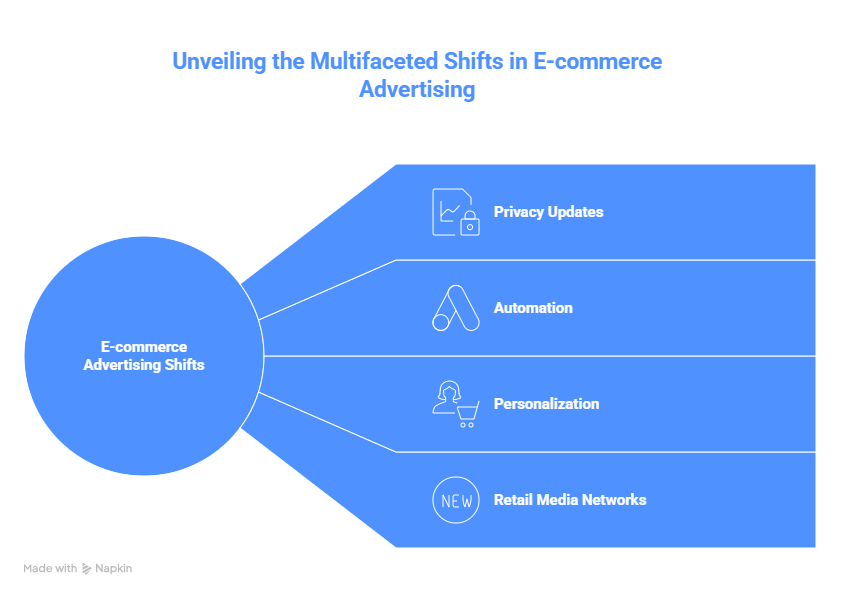
Privacy updates have reduced the effectiveness of broad tracking, which has pushed teams toward first-party data, on-site behavior, and owned audiences instead of long retargeting windows. At the same time, ad platforms are increasing automation across bidding, targeting, and delivery. That can improve efficiency, but it works best when teams set clear limits, apply it to proven campaigns, and actively monitor results.
Personalization is also becoming the baseline rather than a differentiator. Shoppers now expect pricing, shipping, and offers to reflect their location, with consistent messaging from ad to landing page.
On top of that, retail media networks and new ad inventory are expanding where brands can reach buyers close to purchase. These channels add reach, but they also raise the bar for measurement and integration as the mix grows.
Conclusion
Ecommerce advertising works best when strategy, relevance, and execution are aligned. Strong campaigns do more than drive clicks. They reach the right audience, set clear expectations, and deliver a consistent experience after the click.
Personalization and localization are no longer optional. As competition increases and acquisition costs rise, generic ads and generic landing pages become harder to justify. Small mismatches, like the wrong currency or irrelevant offers, add friction that directly impacts conversion rates.
If performance feels capped, it’s worth looking at how well your ads and on-site experience match. Platforms like Geo Targetly help close that gap by making it easier to align ad targeting with location-aware content, pricing, and messaging, without adding operational complexity.

Copywriter