



.webp)










GDPR compliance does not scale through checklists alone. As products and tooling change, earlier decisions can fall out of sync.
A risk-based approach focuses effort where exposure is highest, with consent and data flows at the center. For global teams, location-aware consent helps align regional requirements without maintaining separate setups.
Tools like Geo Consent support this approach by handling regional consent behavior in one place.
Key takeaways:
- GDPR compliance works best as an ongoing practice, not a one-time project
- Risk-based prioritization helps teams focus on real exposure
- Consent design plays a central role, especially for multi-region products
- Product-level privacy decisions are easier to maintain than retroactive fixes
- Regular review and selective automation help prevent compliance drift
GDPR compliance isn’t a one-time task. For most companies, it becomes an ongoing operational responsibility as products grow, data usage expands, and regulations change.
New features, analytics tools, marketing platforms, and vendors all introduce additional personal data risk. Even teams that started with strong compliance foundations can lose control over time.
A GDPR compliance strategy focuses on long-term control rather than short-term fixes. It connects legal requirements with technical and organizational decisions so compliance holds up as the business evolves.
What “GDPR compliance strategy” actually means
A GDPR compliance strategy is a structured, long-term approach to managing personal data risks by aligning legal obligations with technical, organizational, and product-level controls, and keeping those controls usable as the business evolves.
Without it, GDPR compliance remains fragile, reactive, and increasingly expensive to maintain as companies scale.
Many teams treat GDPR compliance as a collection of tasks. Update the privacy policy, add a banner, sign data processing agreements, run an audit once a year, etc.
Those tasks matter, but they’re not a strategy.
A true strategy links policy decisions, technical controls, internal processes, and day-to-day product choices into something that can adapt as the company grows.
Over time, the difference is hard to miss. Task-based compliance reacts late. Strategic compliance prevents many issues from happening at all.
A practical GDPR compliance strategy focuses on:
- How personal data flows through the organization
- Who is responsible for decisions and oversight
- Which risks matter most based on data sensitivity and exposure
- How compliance holds up as tools, vendors, and features change
GDPR compliance tasks vs. compliance strategy
Compliance tasks are individual actions taken to meet specific requirements, whereas a compliance strategy is the framework that determines how those actions are chosen, maintained, and reviewed.
Quick summary to highlight the key differences:
A real strategy makes compliance easier to maintain as the product changes.
Core principles behind effective GDPR compliance strategies
Strong GDPR compliance strategies are built on a small number of foundations. When these are in place, individual compliance decisions become easier and more consistent.
Accountability and documentation
GDPR expects organizations to be able to explain what they are doing with personal data and why. That doesn’t mean documenting everything exhaustively, but it does mean having clear ownership and traceability.
Accountability shows up as:
- Defined responsibility for data protection decisions
- Documented processing activities and lawful bases
- Clear internal escalation paths when risks are identified
Teams that skip this step often struggle later. When no one owns a decision, compliance gaps tend to surface only after something breaks.
Risk-based decision making
Not all GDPR risks carry the same weight. Treating every data processing activity as equally risky leads to wasted effort and compliance fatigue.
Effective strategies prioritize based on:
- Sensitivity of the data involved
- Volume of users affected
- Potential impact of misuse or exposure
- Regulatory and geographic context
A risk-based approach shifts effort away from low-impact work and toward real exposure.
Data minimization and purpose limitation
Two of the most practical GDPR principles are also the most commonly ignored.
Data minimization means collecting only what is needed. Purpose limitation means using that data only for clearly defined reasons.
In real products, this often breaks down when:
- Optional fields quietly become required
- Analytics events accumulate without review
- Data is retained “just in case” it might be useful later
Compliance strategies that enforce regular data reviews and justification checks tend to be simpler and more resilient over time.
Privacy by design and by default
Privacy by design shifts GDPR from a legal afterthought to a product decision. Instead of fixing compliance issues later, teams consider privacy implications during feature design and implementation.
This includes:
- Limiting default data collection
- Restricting internal access by role
- Building deletion and export capabilities early
When privacy is treated as a design constraint rather than a blocker, compliance becomes easier to maintain as products evolve.
Continuous monitoring and improvement
GDPR compliance is affected by constant change. New vendors, new features, new regulations, and new interpretations all introduce risk over time.
Sustainable strategies include:
- Regular internal reviews of data usage
- Vendor reassessments
- Updates to consent and privacy controls as regulations evolve
Teams that review compliance continuously tend to spend less time reacting to urgent issues later.
A risk-based framework for GDPR compliance
One of the biggest mistakes teams make with GDPR is treating all compliance work as equally important. In reality, GDPR risk is unevenly distributed across systems, data types, and workflows.
A risk-based framework helps teams focus effort where it actually matters. Instead of asking “are we compliant,” the better question becomes “where are we most exposed.”
Why not all GDPR risks are equal
The potential impact of a GDPR failure depends on several factors, including the type of data involved, how it is processed, and who has access to it.
For instance, a misconfigured analytics tool collecting anonymous page views does not carry the same risk as a system storing unencrypted customer identifiers or behavioral profiles.
A practical risk-based approach considers:
- Sensitivity of the personal data
- Volume of records processed
- Purpose of processing
- User geography and regulatory exposure
- Third-party vendors involved
Thinking this way, low-impact gaps fade into the background and higher-risk issues stand out.
Building a GDPR risk scoring model
A simple risk scoring model doesn’t need to be complex to be effective. The goal is consistency, not mathematical precision.
Most teams start by assigning scores across a few core dimensions:
- Data type: Basic identifiers vs. sensitive or special category data
- Data volume: Number of users or records affected
- Processing purpose: Core product functionality vs. secondary use cases
- User location: EU, UK, or mixed jurisdictions
- Vendor exposure: Internal systems vs. third-party tools
Each dimension can be scored on a low to high scale. When combined, these scores surface which data flows and systems represent the highest compliance risk.
Example GDPR risk matrix
Teams can use this type of matrix to rank systems, workflows, or vendors. High-scoring areas become priorities for deeper controls, audits, or redesign.
Using risk scores to guide compliance effort
Once risks are ranked, compliance decisions become more practical.
High-risk areas typically require:
- Stronger consent controls
- Clearer lawful basis documentation
- Tighter access and retention policies
- More frequent reviews
Lower-risk areas may only need occasional checks and lightweight documentation.
A risk-based GDPR compliance strategy prioritizes real exposure over theoretical completeness.
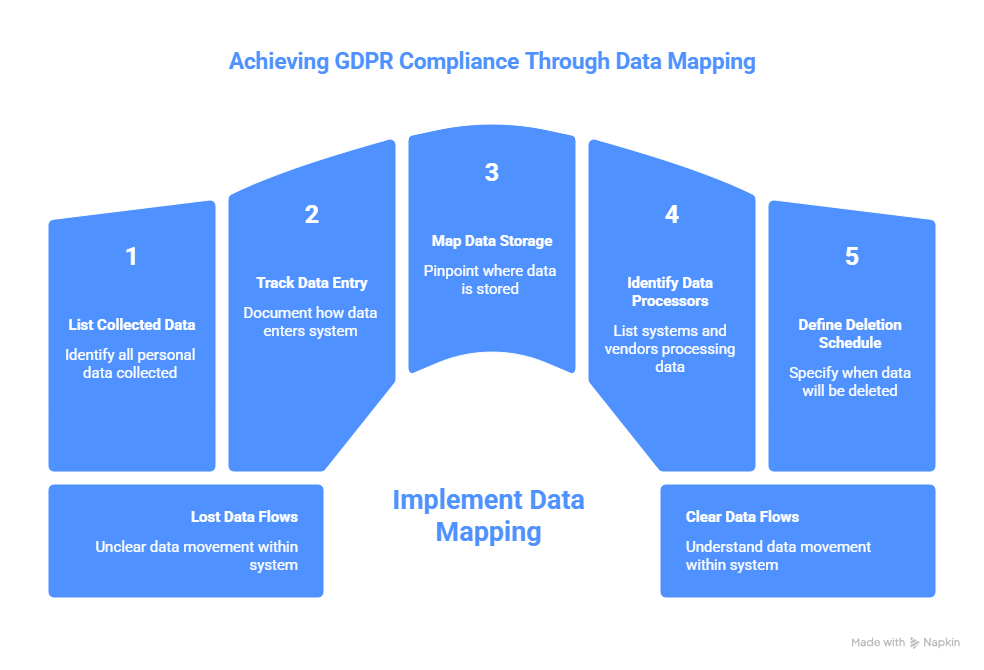
Mapping and controlling personal data flows
GDPR compliance starts to break down when teams lose track of where personal data actually goes.
Most companies know what data they collect at a high level. Fewer can clearly answer where that data moves once it enters the system, which tools touch it, or how long it sticks around.
Data mapping forces that clarity.
At a basic level, it means listing:
- What personal data is collected
- How it enters the product or organization
- Where it’s stored
- Which systems and vendors process it
- When it will be deleted
This doesn’t need to be a complex diagram to be useful. A simple inventory that stays up to date is far more valuable than a polished map that no one revisits.
Linking data to lawful basis and purpose
Data mapping becomes a compliance tool when each data flow is tied to a clear purpose and lawful basis.
Common lawful bases include:
- Contract performance
- Legal obligation
- Legitimate interest
- User consent
Problems usually appear when data collected for one reason starts being reused elsewhere without review. Marketing and analytics tools are frequent sources of this drift.
A practical check is to ask:
- Why is this data needed?
- What breaks if it is removed?
- Who relies on it downstream?
If those questions can’t be answered clearly, the data probably doesn’t belong there.
Common data mapping blind spots
Even teams that map core product data often miss secondary systems.
The most common blind spots include:
- Analytics and event tracking tools
- A/B testing platforms
- Customer support software
- CRM and marketing automation tools
- Embedded third-party scripts
These systems often process personal data by default. Without regular review, they quietly expand data exposure without adding much real value.
Keeping data maps simple and current makes GDPR compliance much easier to maintain. It also feeds directly into risk prioritization, consent design, and retention policies.
Consent management as a core GDPR compliance strategy
Consent is often treated as a legal formality. A banner gets added, a box gets ticked, and the problem is considered solved.
In reality, consent sits at the center of many GDPR failures.
Poor consent design creates two problems at once. It increases regulatory risk, and it degrades the user experience. Over time, both get worse as products expand into new markets and add more data-driven features.
Valid GDPR consent has a few non-negotiable requirements:
- It must be freely given
- It must be specific and informed
- It must be unambiguous
- It must be easy to withdraw
Most issues arise when these requirements are applied uniformly across regions that follow different rules. Consent expectations in Germany, France, and the UK do not always align. ePrivacy enforcement adds another layer of variation.
Tip: To learn more about GDPR’s rules, check out our complete guide to GDPR compliance.
Location-aware consent and regional rules
Static consent banners struggle in multi-country environments. What works in one jurisdiction can be non-compliant in another.
Location-aware consent adapts what users see based on where they are accessing the site or product from.
That includes:
- When consent is required
- Which purposes are presented
- How granular the choices are
- How refusal is handled
Users see fewer interruptions, and consent stays aligned with local rules.
Reducing consent fatigue without increasing risk
Consent fatigue is usually a design problem, not a legal one. When users are asked to approve too many purposes at once, they disengage and get annoyed.
When banners interrupt core actions, they rush through decisions. Both outcomes undermine the quality of consent.
Better consent setups tend to:
- Limit purposes to what is actually needed
- Group related processing logically
- Avoid dark patterns and forced choices
- Respect prior decisions
Using Geo Targetly Geo Consent for scalable compliance
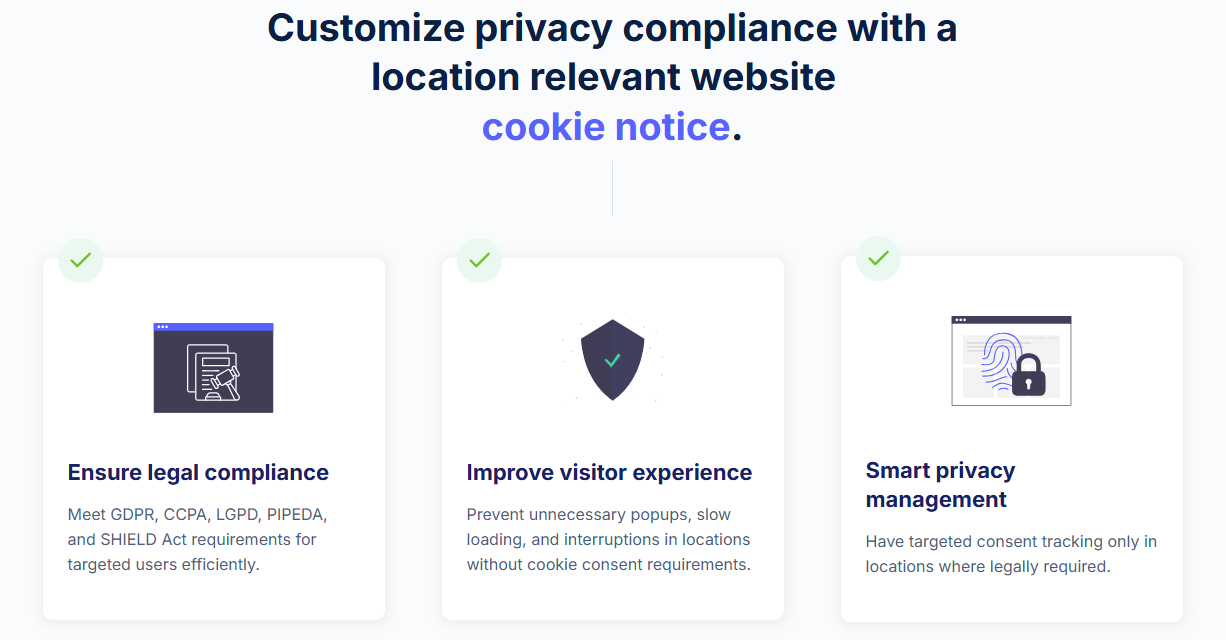
Managing consent across regions becomes difficult as more markets are added. Each new country introduces different expectations, edge cases, and maintenance work.
Geo Consent adapts consent behavior based on user location, avoiding the need to maintain separate consent setups for each country. Consent messaging and behavior adjust based on regional GDPR and ePrivacy requirements.
If you need location-based consent without country-by-country configuration, you can sign up for a free trial of Geo Targetly and see how it works across regions.
Privacy by design and product-level compliance
GDPR becomes harder to manage when privacy decisions are pushed to the end of the development process. Retrofitting compliance after a feature ships usually means workarounds, extra tooling, or partial fixes.
Product teams have more influence on GDPR outcomes than legal teams ever will.
Privacy by design shows up in small, early decisions, like what data a feature collects by default, whether optional fields stay optional, and who inside the company can access user data.
Some patterns that tend to hold up better over time:
- Collecting the minimum data needed for a feature to work
- Separating core functionality from analytics and experimentation
- Limiting access to personal data by role, not convenience
- Logging access to sensitive systems
These patterns are easiest to see in how product teams design and ship features.
Product-level controls in SaaS environments
In SaaS products, GDPR risk often comes from routine product decisions rather than explicit data policies. Onboarding flows and feature rollouts are two of the most common places where unnecessary data collection creeps in.
Onboarding flows are a frequent source of overcollection. Fields added “for later” tend to become permanent, even when they are rarely used or never justified.
A more resilient approach:
- Start with only required fields
- Introduce additional data collection later, tied to a clear product benefit
- Document why each data point exists
Feature flags act as a control layer. They limit exposure while testing, allow regional rollouts without blanket data collection, and make it easier to disable features if compliance concerns arise.
Together, these controls help keep data collection aligned with actual product needs instead of assumptions made early on.
Regional personalization without overcollection
Personalization doesn’t require broad data capture. In many cases, coarse signals are enough.
Location-based personalization is one example. Regional language, currency, or consent behavior can be adjusted without storing detailed personal profiles. When used carefully, this supports compliance instead of undermining it.
Teams that treat privacy as a product constraint tend to move faster over time. That means fewer exceptions, fewer rework cycles, and fewer late-stage compliance surprises.
Scaling GDPR compliance with automation and tooling
Manual GDPR processes break down quickly as teams grow. What works for a small product with a handful of tools becomes unmanageable once data spreads across multiple systems and vendors.
Automation limits human error and repetitive compliance work. Teams still make decisions, but fewer steps depend on manual processes.
Tip: For a full breakdown of the best software and choose which is right for your business, be sure to read our guide to GDPR compliance tools.
Consent management
Consent is one of the first places automation pays off. Handling consent states manually across regions, products, and devices creates gaps almost immediately.
Automated consent tooling helps with:
- Presenting the right consent experience by location
- Storing and updating consent preferences reliably
- Applying consent decisions across connected tools
When consent is centralized, downstream systems behave more predictably.
DSAR workflows
Data subject access requests (DSARs) are easy to underestimate. A single request can touch user accounts, support systems, marketing platforms, and analytics tools.
Automated DSAR workflows help:
- Identify which systems contain user data
- Track request deadlines
- Standardize responses and approvals
Response times improve, and fewer requests fall through gaps.
Data retention and deletion
Retention policies often exist on paper but fail in practice. Data lingers because deletion depends on manual steps or unclear ownership.
Automation improves retention by:
- Enforcing deletion schedules
- Applying rules consistently across systems
- Reducing reliance on individual team members
Clear retention controls also make audits far easier.
Audit logging and monitoring
Access logs and activity records rarely get attention until something goes wrong. At that point, gaps are expensive.
Automated logging supports:
- traceability of data access
- internal investigations
- regulatory inquiries
Tooling considerations for growing teams
Geo Targetly's Geo Consent works alongside existing tools and handles regional consent differences without separate country setups.
Industry-specific GDPR compliance strategies
GDPR looks the same on paper across industries. In practice, risk shows up in different places depending on how data is collected and used.
Industry-specific strategies help teams focus on the areas most likely to cause problems, rather than spreading effort evenly across everything.
Let’s cover some common risk areas and specific strategies to combat each across several industries.
GDPR compliance strategies for SaaS
SaaS products tend to process personal data continuously. Accounts persist over time, features evolve, and third-party tools are often deeply embedded into the product.
Risk usually builds up in the same places, especially as products mature and stacks grow.
For most SaaS teams, compliance holds up better when it is treated as part of ongoing product maintenance, not a one-off legal task.
GDPR compliance strategies for e-commerce
E-commerce environments handle large volumes of transactional and behavioral data. The same customer record often passes through checkout systems, marketing tools, analytics platforms, and third-party scripts, sometimes with little coordination between them.
Risk tends to concentrate in a few predictable areas.
Location-aware consent matters more in e-commerce than in many other industries. Traffic often spans multiple jurisdictions, and a single static setup rarely fits every market.
GDPR compliance strategies for marketing teams
Marketing teams usually control the most changeable data workflows. Campaigns launch quickly, tools change often, and experimentation is ongoing. That pace makes compliance harder to maintain without clear guardrails.
Problems tend to show up in these familiar places.
Marketing teams that stay aligned with product and compliance functions tend to avoid the most expensive mistakes, especially as tooling and campaigns scale.
Industry comparison overview
For quick and easy reference, here’s a comparison of all three:
Measuring and maintaining GDPR compliance over time
GDPR compliance drifts as products and tooling change. Without regular review, earlier decisions stop matching how personal data is handled, which is why measurement and review routines matter.
Compliance signals worth tracking
Not everything needs a metric. A short list of signals is usually enough to spot problems.
Commonly tracked areas include:
- Number and type of personal data processing activities
- Volume and turnaround time of DSARs
- Consent opt-in and withdrawal rates
- Number of active third-party processors
- Incidents involving data access or exposure
These signals don’t need to live in a dashboard to be useful. Regular visibility matters more than perfect reporting.
Internal reviews and audits
Internal reviews tend to be more effective when they are narrow and frequent.
Instead of large annual audits, many teams run:
- Quarterly reviews of high-risk systems
- Periodic checks of consent behavior by region
- Vendor reassessments when tools change, not on a fixed calendar
Reviews work best when ownership is clear. Someone should be responsible for following up on findings, even when the issues seem minor.
Keeping up with regulatory and product changes
GDPR enforcement and interpretation continue to evolve. Product changes create just as much risk as regulatory updates.
Teams usually need to reassess compliance when:
- Launching in a new country
- Adding tracking or personalization features
- Introducing new vendors or integrations
- Changing how data is stored or retained
Treating these moments as triggers for review keeps compliance aligned with how the product actually operates.
Common GDPR compliance mistakes to avoid
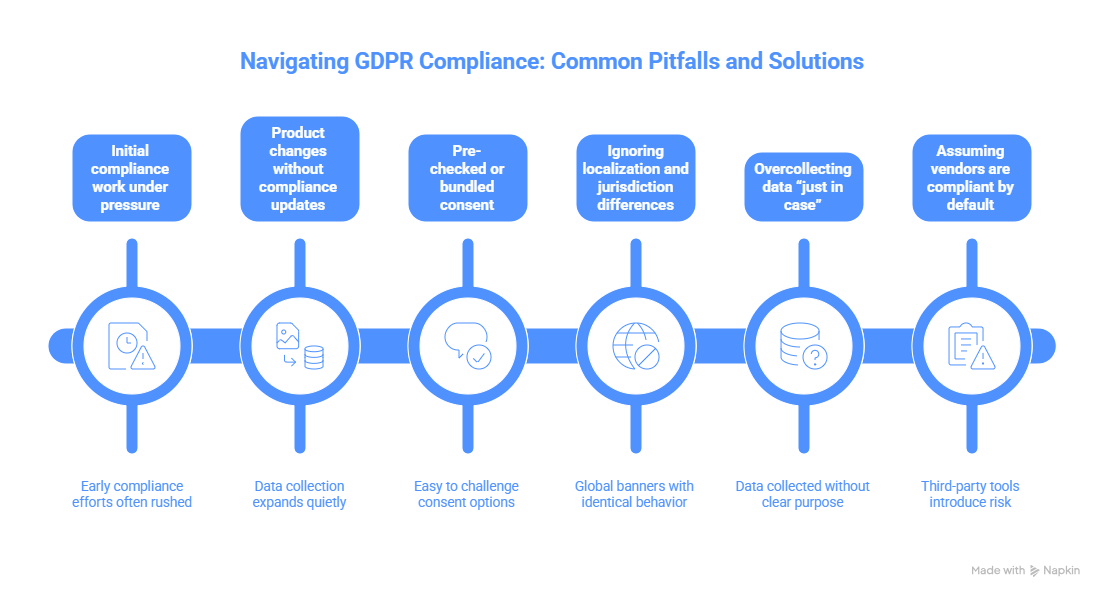
Most GDPR issues are not caused by a lack of awareness. They happen because teams rely on assumptions that stop being true as the business grows.
These mistakes show up repeatedly across audits, enforcement actions, and internal reviews.
Treating GDPR as a one-time project
Initial compliance work often gets done under pressure.
Months later, the product has changed and the compliance setup has not. Data collection expands quietly, while controls stay the same.
GDPR needs ongoing attention. Without it, early work loses value quickly.
Relying on pre-checked or bundled consent
Pre-checked boxes and bundled consent options are still common, even though they are easy to challenge.
Consent that is rushed or forced tends to fall apart under scrutiny. It also leads to poor data quality, since users disengage rather than make informed choices.
Clear, granular consent reduces both risk and user frustration.
Ignoring localization and jurisdiction differences
Global banners with identical behavior across regions are convenient, but rarely accurate.
Consent expectations differ by country. Enforcement priorities vary. Treating all users the same often leads to either overblocking or undercompliance.
Location-aware approaches handle this without fragmenting systems.
Overcollecting data “just in case”
Data collected without a clear purpose becomes a liability. It increases breach impact, complicates retention, and raises questions that are hard to answer later.
If data does not serve an active product or legal need, it should be reconsidered.
Assuming vendors are compliant by default
Third-party tools are a frequent source of exposure. Even well-known vendors can introduce risk through configuration choices or data sharing practices.
Regular vendor reviews matter, especially when tools handle consent, analytics, or user communication.
Final thoughts: Turning GDPR compliance into a competitive advantage
GDPR is often treated as a constraint, something to manage or work around. Teams that handle it well usually see the opposite effect: clearer boundaries around data use, fewer consent edge cases, and fewer surprises when the product changes.
The difference shows up operationally in fewer urgent fixes, fewer last-minute reviews, and fewer surprises when partners or regulators ask questions. Instead of chasing perfect compliance, these teams build systems that stay usable as the business grows.
For global products, consent and localization are part of that picture, and tools like Geo Consent support that approach by handling regional consent behavior in one place.
Handled this way, GDPR becomes part of how a product scales responsibly, not something that needs to be reworked every time the business changes.

Copywriter