



.webp)










International ecommerce is more than shipping globally, it means adapting your store to local expectations around language, currency, payments, delivery, returns, and compliance. Brands win internationally when they start with markets showing real demand, remove checkout friction (local pricing, trusted payment methods, clear duties and shipping), and use location-aware localization to improve conversion without building separate sites for every country.
Key takeaways:
- A clear explanation of what international ecommerce involves in practice
- The most common challenges teams run into when selling globally
- Localization approaches that improve performance across regions
- Practical ways to approach market expansion
- Key trends shaping international ecommerce over the next few years
Expanding an ecommerce business internationally sounds straightforward at first. Open shipping to more countries, turn on additional currencies, and wait for demand to grow.
That’s where many teams get stuck.
International traffic arrives, but conversion rates lag. Customers drop off during checkout. Questions about pricing, shipping, and taxes pile up. Growth potential is there, but the experience does not hold up across markets.
International ecommerce works differently once you move beyond your home country. Buyers bring different expectations around language, payments, delivery, and trust. Small mismatches in those areas can quietly limit performance, even when demand exists.
What is international ecommerce?
International ecommerce means selling online to customers outside your home country in a way that reflects how people in those markets actually buy.
It goes further than accepting international orders. It includes how prices are shown, which payment methods are offered, what shipping information looks like, and whether the experience feels credible to someone shopping from another country.
International e-commerce often involves:
- Showing prices in local currencies.
- Offering payment methods people already trust.
- Providing clear shipping timelines and return policies by region.
- Making sure language, formatting, and messaging make sense locally.
- Following country-specific tax, privacy, and consumer protection rules.
A customer in Germany, for example, may be perfectly willing to buy from a US brand. That willingness drops quickly if prices are only in dollars, shipping costs are unclear, or checkout feels unfamiliar.
Tip: Take a look at our guide on how to grow your e-commerce business to get tips on how to create a well-rounded strategy.
International e-commerce vs. domestic selling
Domestic e-commerce assumes a shared context. Language, currency, shipping expectations, and legal rules are mostly consistent.
International e-commerce removes that shared baseline. Each visitor brings different expectations depending on where they are buying from.
Some of the key differences include:
Because of these differences, international e-commerce tends to surface issues that don’t exist at home. Conversion problems often have less to do with demand and more to do with expectations not being met.
Selling internationally is not the same as being international
Many brands technically sell worldwide but treat international visitors as an afterthought. Everyone sees the same site, the same prices, and the same messaging.
That approach usually works up to a point. After that, growth slows.
International sales start to work when brands adjust the experience based on where the customer is, not just where the business is based.
That shift becomes especially important once international traffic makes up a meaningful share of sessions or revenue.
Global e-commerce market size and outlook
Global retail e-commerce sales continue to grow year over year. Public forecasts consistently place worldwide retail e-commerce sales in the mid-$6 trillion range today, with projections reaching close to $8 trillion by 2027, accounting for more than 20% of total global retail sales.
Growth has slowed in some mature markets, but total volume continues to rise as more regions move online and international purchasing becomes more common.
The shift is not only about scale. A growing share of online revenue now comes from buyers outside a brand’s home market.
Share of cross-border e-commerce
Cross-border e-commerce represents a meaningful and growing portion of global online sales, although exact percentages vary depending on how it is measured.
Estimates place the global cross-border e-commerce market at around $1.1-1.5 trillion in the mid-2020s, with strong growth expected over the next decade.
Other market research projects the cross-border e-commerce market reaching $4.8 trillion by the early 2030s, reflecting continued international adoption.
A practical indicator of this growth is parcel volume. Cross-border shipments, particularly low-value international parcels, have increased sharply in recent years, driven by global marketplaces and direct-to-consumer brands.
For brands, this signals that international demand already exists. The challenge is turning that demand into consistent revenue.
Mobile vs. desktop trends
Mobile commerce represents more than half of global e-commerce activity, with especially high adoption in Asia-Pacific and emerging markets.
In many regions, mobile is the primary shopping channel rather than an alternative. Desktop still plays a role for higher-value purchases and B2B buying, but mobile-first experiences are increasingly expected.
B2C vs. B2B contribution
While B2C e-commerce receives more public attention, B2B e-commerce is larger by total transaction value globally.
Multiple industry estimates show B2B e-commerce exceeding B2C in overall volume, driven by wholesale, manufacturing, and cross-border procurement
Source: SellersCommerce
For brands operating in both direct-to-consumer and wholesale channels, international e-commerce often supports both sides of the business, with very different expectations around pricing, payments, and logistics.
Why these numbers matter
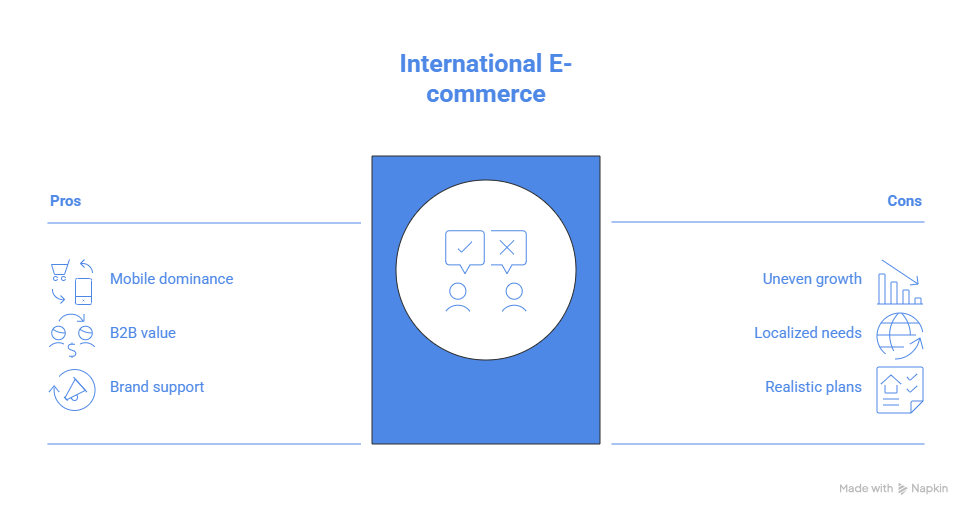
International e-commerce is growing, but not evenly. Growth differs by region, device, and business model.
Brands that treat international traffic as secondary often miss where that growth is actually coming from. The data points to a clear pattern: opportunity exists, but it rewards focus, localized experiences, and realistic expansion plans rather than one-size-fits-all global launches.
Why international ecommerce matters for growth focused brands
At some point, most e-commerce teams hit the same wall. The home market starts to feel crowded, ads get more expensive, and new campaigns move the needle less than they used to. Here’s why you need to start paying attention before you feel the effects.
Home markets eventually saturate
In mature markets, the same audiences are targeted again and again. Competition increases, costs rise, and growth slows. Expanding into new regions opens access to customers who have not been reached as aggressively.
Revenue becomes more resilient
Selling in multiple countries spreads risk. Demand varies by season, economy, and region. When one market slows, another may be growing, which helps stabilize revenue over time.
Early localisation creates an edge
Brands that adapt early tend to feel more familiar in new markets. Clear language, local pricing, and relevant messaging improve conversion. Waiting often means competing later against brands that already feel established.
Acquisition costs vary by region
Advertising costs are not the same everywhere. Some markets offer lower CPMs (Cost Per Mile) and CPCs (Cost Per Click), which can extend paid growth. That advantage only holds if the on-site experience matches local expectations.
Treating all visitors the same limits growth
When every visitor sees the same site, pricing, and messaging, conversion rates flatten. Location becomes another signal, alongside device or traffic source, that shapes how the experience should adapt.
The biggest challenges of international ecommerce & how to solve them
Most international ecommerce problems are not about demand. They show up after traffic is already there and conversions are not. The gaps usually come from small frictions that add up fast once you cross borders.
Localization and language gaps
Language is often the first issue teams notice, but it is rarely just about translation. Even when customers understand English, unfamiliar phrasing, formats, or references can make a site feel distant or unreliable.
This usually shows up as higher bounce rates and lower add-to-cart activity in non-core markets.
What helps: Focus on clarity over perfection. Localize key pages first, especially product pages, checkout steps, and trust signals. Adjust tone, measurements, and seasonal references so the content makes sense where the customer lives.
Currency, pricing, and payment friction
Seeing prices in the wrong currency or being forced to calculate conversions creates hesitation.
Payment methods add another layer. Many customers abandon checkout simply because they don’t see an option they recognize or trust.
This is one of the most common causes of international cart abandonment.
What helps: Show prices in local currencies and formats. Support the payment methods that are standard in each region, not just globally popular ones. Make costs clear early so customers are not surprised at checkout.
Shipping, delivery, and returns confusion
International shipping raises practical questions. Where is the item shipping from? How long will it take? What happens if it needs to be returned?
When those answers are missing or vague, customers hesitate, especially on higher-value orders.
What helps: Set expectations upfront. Show delivery times, shipping costs, and return rules based on the visitor’s location. Even if shipping takes longer in some regions, clarity performs better than optimism.
Taxes, duties, and compliance complexity
Unexpected taxes or duties are a fast way to lose trust. Customers often abandon orders when fees appear late in the process or at delivery.
Compliance adds another layer. Privacy rules, consumer rights, and tax regulations vary by country, and ignoring them can create legal and operational risk.
What helps: Be transparent about what is included in the price and what is not. Use tax and duty calculations where possible, and explain them clearly. Show the right legal notices to the right users without overwhelming everyone else.
Treating all international visitors the same
A common pattern is building one global site and assuming it will work everywhere. Over time, this flattens conversion rates. Visitors from different regions behave differently, expect different information, and respond to different cues.
What helps: Treat location as a meaningful input, not an edge case. Adjust content, pricing, messaging, and offers based on where the visitor is coming from. This doesn’t require separate sites for every country, but it does require flexibility in how the experience adapts.
International ecommerce expansion strategies
International expansion works best when it is intentional and staged. Trying to launch everywhere at once usually creates more complexity than growth. Teams that see consistent results tend to follow a clear sequence: identify demand, adapt the experience, then scale what works.
Fastest-growing regions
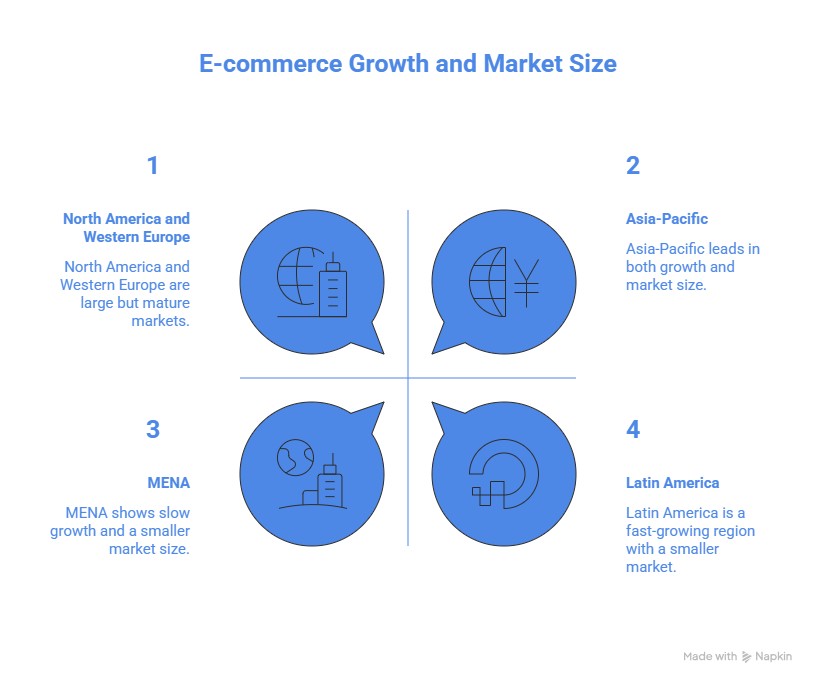
E-commerce growth is not evenly distributed across regions.
- Asia-Pacific remains the largest e-commerce region by total sales value, driven by China, India, and Southeast Asia. China alone accounts for a substantial share of global online retail.
- Latin America is among the fastest-growing regions, with countries like Brazil and Mexico showing double-digit annual growth.
- Middle East and North Africa (MENA) continues to expand as payment infrastructure improves and mobile usage increases.
- North America and Western Europe remain large but more mature markets, with slower growth compared to emerging regions.
This uneven growth is why many brands focus on selective expansion rather than trying to “go global” everywhere at once. Using this knowledge will help you shape your action plan.
Choose markets based on real signals
The safest place to start is where interest already exists. Most brands can spot early indicators in their own data.
Look for:
- Countries sending consistent traffic
- Higher engagement but lower conversion rates
- Repeat international customers despite a non-local experience
- Support inquiries from the same regions
Combine this with basic market checks, such as market size, competition, shipping feasibility, and payment preferences. This helps narrow focus to a small number of priority regions.
Start small and validate before committing
You do not need a fully localized store to test a market. Many teams begin by adapting only the most visible parts of the experience.
Common early tests include:
- Local currency display
- Region-specific messaging on key pages
- Adjusted shipping information
- Targeted landing pages for paid campaigns
These tests help confirm demand before investing in inventory changes, translations, or local operations.
Decide between one global store and multiple regional sites
There is no single right structure. Some brands run one global site with location-based adjustments. Others maintain separate regional stores.
Many brands start with one site and move to regional sites only when scale demands it.
Align logistics early
Shipping, delivery times, and returns shape international customer expectations quickly. These details should be addressed before scaling traffic.
Important considerations include:
- Fulfillment locations and shipping routes
- Delivery time consistency by region
- Return handling and costs
- Local customer service expectations
Partnering with experienced logistics providers can help avoid surprises as volume grows.
Use location awareness to guide growth
Location data helps teams adapt without rebuilding everything for each market. It allows small changes to the experience that reflect where visitors are coming from
Many teams address these challenges by making their site location-aware rather than building separate stores for every market.
Platforms like Geo Targetly allow teams to adjust content, pricing displays, messaging, redirects, and compliance notices based on visitor location, while keeping a single site structure. This makes it easier to localize key parts of the experience without increasing operational overhead.
International expansion tends to work best when teams treat it as a learning process rather than a one-time launch.
Regional differences in international ecommerce
International ecommerce does not behave the same way everywhere. Expectations around pricing, payments, delivery, and trust change by region, and those differences show up quickly in conversion data.
Understanding these patterns helps teams decide where to adapt first and what actually needs to change.
Fastest-growing regions
E-commerce growth is not evenly distributed across regions.
- Asia-Pacific remains the largest e-commerce region by total sales value, driven by China, India, and Southeast Asia. China alone accounts for a substantial share of global online retail.
- Latin America is among the fastest-growing regions, with countries like Brazil and Mexico showing double-digit annual growth.
- Middle East and North Africa (MENA) continues to expand as payment infrastructure improves and mobile usage increases.
- North America and Western Europe remain large but more mature markets, with slower growth compared to emerging regions.
This uneven growth is why many brands focus on selective expansion rather than trying to “go global” everywhere at once. Knowing market specifics helps you create a well-thought-out action plan.
Europe
Europe is often treated as a single market, but behavior varies widely by country.
Common characteristics:
- Strong expectations around privacy and data protection
- High sensitivity to delivery costs and return policies
- Preference for local language content, even when English is widely spoken
Payment behavior also differs. Card payments are common in some countries, while bank transfers and invoice-based options are standard in others. Clear pricing and transparent taxes matter, especially in VAT-regulated markets.
North America
The US and Canada share many habits, but there are important differences.
In the US:
- Fast shipping is often expected
- Promotions and discounts strongly influence buying decisions
- Credit cards dominate checkout
In Canada:
- Shoppers are more cautious about cross-border fees
- Duties and shipping costs affect conversion earlier
- Local currency pricing makes a noticeable difference
Treating both markets the same often leads to unnecessary drop-off, especially around checkout.
Asia-Pacific
Asia-Pacific is diverse, but several patterns are consistent across the region.
- Mobile shopping dominates in many countries
- Digital wallets and local payment apps are widely used
- Social commerce plays a larger role than in Western markets
Trust and detail matter. In some countries, buyers expect very detailed product information. In others, speed and convenience take priority. Mobile performance and checkout simplicity are especially important.
Latin America and emerging markets
These regions often show strong growth alongside operational challenges.
Common factors include:
- Lower credit card penetration
- High use of local payment methods or installment options
- Greater sensitivity to delivery reliability and communication
Mobile-first experiences matter here as well. Clear messaging around shipping, payment options, and customer support helps reduce hesitation for first-time buyers.
Why regional differences matter
Many international conversion problems come from assuming buyers behave the same way everywhere. Small mismatches, such as the wrong payment method or unclear delivery terms, can block otherwise interested customers.
Teams that adjust experiences by region tend to see steadier growth than those relying on a single global setup.
International e-commerce trends shaping the next 3-5 years
International e-commerce is still growing, but the way brands compete is changing. The next phase is less about simply selling across borders and more about how well the experience matches local expectations at scale.
Local experiences will become the baseline
International shoppers increasingly expect websites to adapt automatically. That includes language, currency, payment options, and delivery information. Brands that rely on generic global experiences will struggle to keep conversion rates steady as competition increases.
This shift is already visible in how larger retailers operate, and it is gradually becoming the standard rather than a differentiator.
Location data will play a bigger role in personalization
Personalization is moving beyond behavior alone. Location is becoming a core input alongside device type, traffic source, and past interactions.
This shows up in areas like:
- Region-specific product recommendations
- Offers tied to local events or seasons
- Content and messaging adjusted by country or region
Some teams combine behavioral data with location-aware tools, such as those offered by Geo Targetly, to manage this without creating separate sites for every market.
Mobile will dominate even more of the buyer journey
Mobile already drives a large share of international traffic, and its role continues to expand. In many markets, mobile is the primary shopping device, not just a discovery channel.
This increases the importance of:
- Fast load times on mobile networks
- Simple checkout flows
- Payment methods designed for mobile use
Desktop still matters, especially for higher-value and B2B purchases, but mobile performance often determines whether international visitors stay or leave.
Payments will keep fragmenting by region
There is no single global payment standard. Local wallets, bank transfers, and installment options continue to grow alongside cards.
Over the next few years, brands will need to:
- Support more region-specific payment methods
- Maintain consistent checkout experiences across markets
- Adjust payment options as local preferences evolve
Payment flexibility will increasingly affect which markets are viable for expansion.
Compliance and privacy expectations will tighten
Data protection and consumer rights regulations continue to expand beyond a few regions. New rules are emerging in more countries, each with different requirements.
International ecommerce teams will need systems that:
- Show the right notices to the right users
- Handle consent and data use by region
- Adapt as regulations change
This will become a standard operational requirement rather than a one-time setup.
Faster cross-border logistics will raise expectations
Shipping times are improving globally, and with that comes higher expectations. Customers compare delivery experiences across borders, not just within their own country.
Clear communication around delivery timelines, fulfillment locations, and returns will matter as much as speed itself.
What this means for international growth
The next phase of international e-commerce favors brands that treat location as a core part of their strategy. Growth will come from adapting experiences intelligently, not from launching more storefronts or expanding blindly into every market.
Final thoughts: How to succeed
International ecommerce is no longer optional for brands that want to keep growing. Demand already exists across borders. The difference between teams that scale successfully and those that stall usually comes down to execution.
The brands that perform well internationally tend to do a few things consistently. They focus on a small number of markets instead of trying to launch everywhere at once. They adapt the experience based on where customers are located, rather than treating international traffic as secondary. And they make pricing, payments, shipping, and policies easy to understand before customers reach checkout.
International ecommerce rewards brands that pair global reach with local understanding. When those two align, expansion becomes more predictable and easier to scale.
FAQs
What is international ecommerce?
International ecommerce refers to selling products or services online to customers outside your home country. It includes adapting pricing, payments, shipping, content, and compliance to match how people in different regions shop.
What is the difference between international and cross-border e-commerce?
Cross-border e-commerce typically refers to the act of shipping products across borders. International e-commerce is broader. It covers the entire buying experience, including localization, payment methods, taxes, delivery expectations, and legal requirements.
What are the biggest challenges in international ecommerce?
Common challenges include unclear pricing, limited payment options, shipping and return confusion, tax and duty surprises, and experiences that do not match local expectations. These issues often appear as lower conversion rates outside a brand’s core market.
Which countries are best for e-commerce expansion?
There is no single best answer. Strong candidates are usually countries that already show demand in your analytics, have reliable logistics infrastructure, and support common payment methods. Many brands start with nearby or culturally similar markets before expanding further.
How do you localize an e-commerce website?
Localization usually starts with high-impact areas, such as product pages, pricing, checkout, and shipping information. This can include language adjustments, local currency display, region-specific payment methods, and clear delivery and return details.
How do taxes work in international e-commerce?
Tax rules vary by country. Some markets require VAT or GST to be included in pricing, while others apply duties at checkout or delivery. Many brands use tax calculation tools and location-based messaging to clarify what customers should expect.
Is international ecommerce worth it for small businesses?
It can be, especially when demand already exists. Small businesses often succeed by starting with one or two markets, testing localized changes, and scaling gradually rather than committing to full international operations upfront.

Copywriter